My three-year-old daughter whacked me across the head the other day with a big stick. When I said, “Erin! That really hurt,” she came back with, “I’m not Erin, I’m Rumi!”
I’ve never been more proud.
Before you clutch your pearls too tightly, I’m not condoning violence. I reminded her to be gentle, and was thankful I was her target and not another child. But, isn’t it a breath of fresh air to have a kids’ film where three female leads are the ones kicking arse? Not just kicking arse, kicking boys’ arses. This is this generation’s Bend It Like Beckham and I’m absolutely here for it.
If you haven’t seen it yet, the gist is this: three K-pop idols who moonlight as demon hunters take on monsters, boy bands, and their own insecurities. It’s flashy, funny, surprisingly deep, and way more meaningful than you’d expect from a kids’ film.
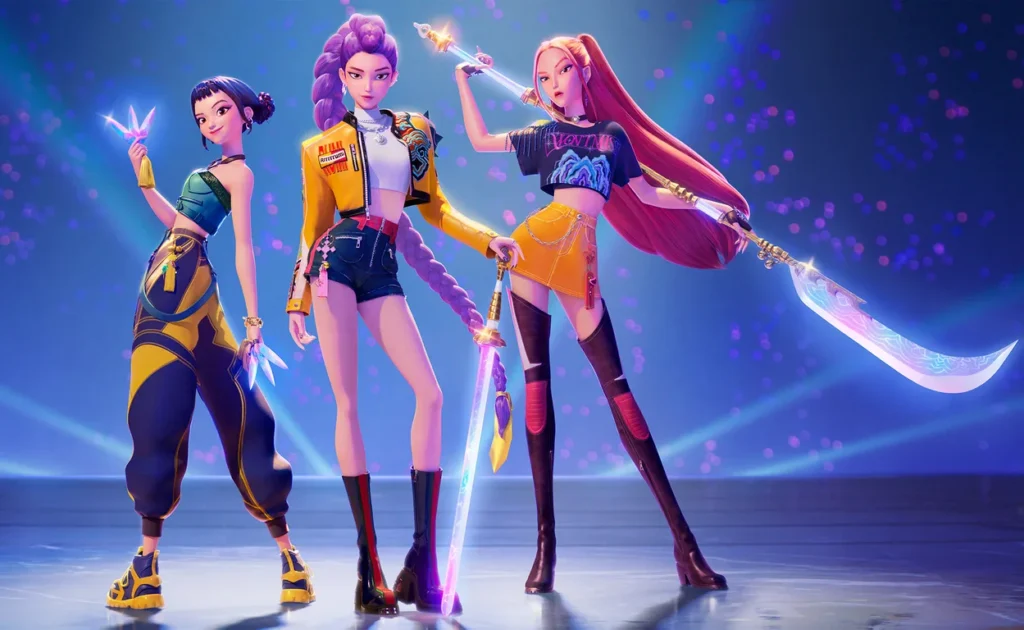
K-pop as a cultural phenomenon has mostly skipped past me. I know it’s massive (I know because I’m now seeing shows about it with people like the Spice Girls and Bruno Mars), I just don’t tend to catch a lot of music trends until way after (sorry, I’m still listening to Creep by Radiohead). But that hasn’t stopped me humming along to Golden whilst I ask myself:
“Why do I like this film so much?”
Every day is KPop Demon Hunters day!
My youngest daughter and son are obsessed. It’s on daily, so I’ve had a lot of time to ponder the question, and I think the answer is this: it pushes back against so many films-for-kids stereotypes.
- Girls are weak? Not these girls.
- Girls don’t eat? These girls definitely do.
- Girls need saving? Forget it. These girls are the saviours.
Shame and guilt
What makes the film more than just fluffy fun is what it says about shame and identity. A Psychology Today article summed it up perfectly: the girls aren’t just fighting demons on the outside, they’re fighting on the inside too. Rumi is half-demon, half-hunter. She hides the demon part of herself because she’s been told people won’t love her if they see it. That’s the core of shame, right? Hiding the bit of you that you think makes you unworthy?
We all have parts of ourselves we’d rather fence off – grief, guilt, insecurities, stuff we think is ugly. But avoiding them, or lessening them for the comfort of others, only causes an internal self-loathing. What Demon Hunters shows is that the only way forward is to own ALL of it. The ‘ugly’ parts too.
And that’s where the film cuts deeper than my daughter with a stick. The villains don’t just punch, they whisper. They use shame and guilt as weapons. They try to control Rumi by making her afraid of herself. If that isn’t a metaphor for real life (not to mention beauty industry marketing 101), I don’t know what is.
Teaching my kids that lesson? Well worth the welt on my head.
Identity and power
Keeping part of yourself hidden is a familiar thing for lots of people — whether that’s being LGBTQ, or simply being different from your family and friends in your politics, your religion, or your beliefs.
Rumi’s story taps straight into that. Even if it’s never said outright, her struggle to hide part of herself so she can fit in, mirrors the experience of so many people who’ve had to pretend they’re something they’re not.
Then there’s the bigger picture – the pressure to be perfect. These girls are idols. They’re meant to be flawless, untouchable, adored. And yet privately they’re greedy, quirky, insecure, exhausted, sometimes falling apart. That tension between public persona and private struggles? Spot on.
Is insecurity a female quality? No, it effects us all. And with the state of mental health in young boys and men, you could totally write this message in a film where boys are the heroes. But don’t we have enough of those? Sometimes you have to let the needle swing the other way a bit, or in this case a lot! These girls rock. I’m glad my daughter (and my son for that matter) have strong, imperfect female role-models. They’re messy and complicated, and it matters that they win by facing up to who they are, not by hiding away the difficult parts.
I’ll say again, I love KPop Demon Hunters! If you haven’t seen it, treat yourself to a movie night and watch it on Netflix. It’s not just a fun soundtrack and fight scenes. It’s a film about wholeness, shame, power, and what it means to stop hiding and step into yourself.
And if my three-year-old wants to whack me with a stick because she thinks she’s Rumi? Honestly, I’ll take it.
I’ll leave you with the lyrics to the final battle scene/song:
What It Sounds Like
I broke into a million pieces, and I can’t go back
But now I’m seeing all the beauty in the broken glass
The scars are part of me, darkness and harmony
My voice without the lies, this is what it sounds like
Why did I cover up the colours stuck inside my head?
I should’ve let the jagged edges meet the light instead
Show me what’s underneath, I’ll find your harmony
The song we couldn’t write, this is what it sounds like
We’re shattering the silence, we’re rising, defiant
Shouting in the quiet, “You’re not alone”
We listened to the demons, we let them get between us
But none of us are out here on our own
So we were cowards, so we were liars
So we’re not heroes, we’re still survivors
The dreamers, the fighters, no lying, I’m tired
But dive in the fire, and I’ll be right here by your side
We broke into a million pieces, and we can’t go back
But now we’re seeing all the beauty in the broken glass
The scars are part of me, darkness and harmony
My voice without the lies, this is what it sounds like…
Songwriters: Stephen Kirk / Hong Jun Park / Jenna Andrews / Ejae / Jeong Hun Seo / Daniel Rojas / Mark Sonnenblick / Hee Dong Nam / Joong Gyu Kwak / Yoo Han Lee
What It Sounds Like lyrics © Yg Entertainment, Wc Music Corp., Maisie Beats, Maisie Anthems, Sixteen Sound Music, The Black Label Inc.