This isn’t my first flag debate. I grew up in London in the 90s, on the arse end of BNP-style nationalism. Chants like “There ain’t no black in the Union Jack” could be heard in pubs and, as hard as it is to reconcile now, in the homes of extended family.
I didn’t understand then, and I don’t understand now, the idea of disliking someone based on skin colour or country of origin.
In my experience, these ideologies tend to be conscribed to the masses, not individuals. “He’s alright.” “No, not her, she’s one of the good ones.” And by that logic, you could say “send them back” without feeling awkward around people you knew personally, that were born elsewhere.
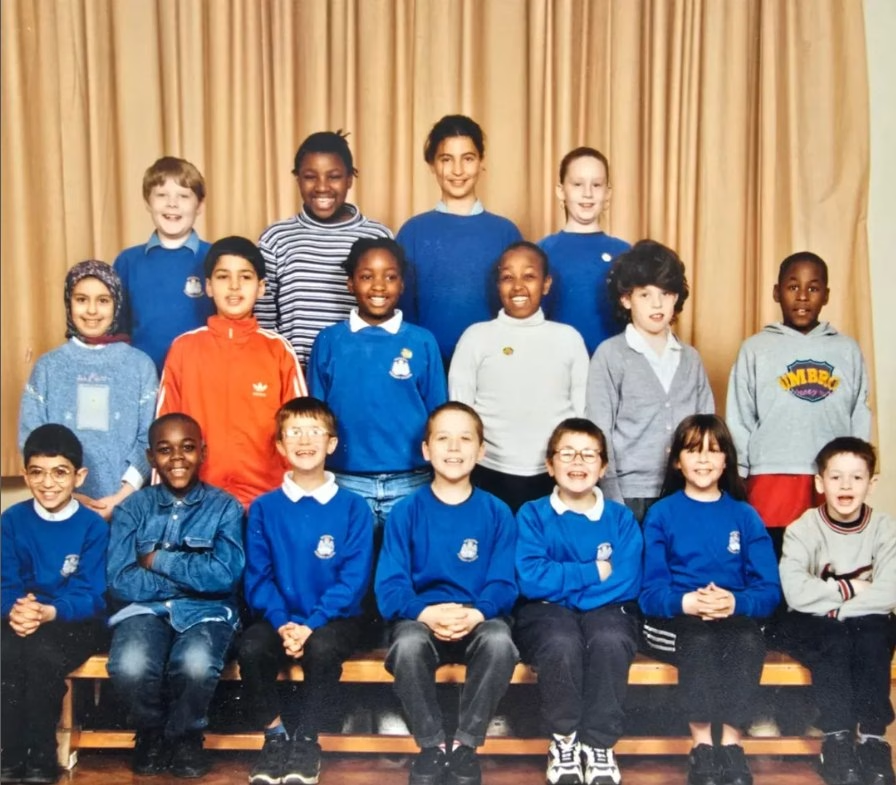
I was familiar with the concepts of asylum and multiculturalism before I even understood the words. As young as five or six, I was sharing lunch with refugees from Yugoslavia, Syria, Bangladesh, playing hide and seek with kids from India, Pakistan, Jamaica, Nigeria. I called them my friends. They invited me to celebrate Diwali, Easter, and Eid with their families. My mum would drop me off and say, “If you don’t like the food, be polite.” I always liked the food.
I never felt like it was them and me. My passport says White British, but that’s never the full story, is it? We’re a nation of mongrels. I’m the descendant of falconers rooted here since medieval times, a post-war Hungarian Jew, and an apartheid-era South African who came to England for work.
In RE (Religious Education), my classmates taught me as much as our teacher did. In History, the subject matter was personal to many. I remember watching a documentary on the Holocaust, wheeled out to us on a shit TV and jumpy VHS. The persecution of millions of Jews that, for want of luck and circumstance, would have killed me generations ago.
It didn’t start with “gas the Jews.” It started with ugly caricatures blaming Jewish neighbours for German misery. Then came the plans for relocation (send them to Madagascar!), then laws that made German-born Jews foreigners in their own country.
The Overton Window
The term comes from Joseph Overton, an American analyst in the 90s. He showed that at any given moment there’s a “window” of ideas considered acceptable in mainstream debate. Ideas outside the window are unthinkable or radical. Ideas inside it are sensible or mainstream.
Once an idea is spoken out loud, even if it’s condemned, it moves the window. The unthinkable becomes discussable. The discussable becomes debatable. And the debatable becomes policy.
That’s how it happens. That’s how we go from blaming a neighbour for your bad luck to justifying genocide.
Hitler wrote in Mein Kampf that gassing fifteen thousand Jews in the trenches of WWI might have saved Germany. A line of grotesque fantasy became the manifesto of a government in one of the most advanced nations of its time.
And we gave ground. “We don’t agree with killing Jews, but he does have a point about migration, about the economy, about disenchanted young German men.” The window shifts again. “He has a point about Austria, about the Treaty of Versailles being too harsh. Let him have it…” Window shifts again.
When has appeasing racism ever worked? Then? Brexit? Now?
Again, migrants are talked about as floods, waves, infestations, invasions. “Illegal.”
There’s nothing illegal about seeking asylum, the Refugee Convention makes that clear, but we’ve let the terminology enter the mainstream unchecked. The window shifts, and my thoughts go to old friends, and new friends, from Poland, Sri Lanka, India, the Congo, Nigeria. How must they feel?
Nationalism replaced with “patriotism”.
“There ain’t no black in the Union Jack” replaced with “refugees not welcome here.”
Madagascar replaced with Rwanda.
Gas chambers replaced with deportation to the Taliban.
All wrapped in the flag and called love of country.
And while the government should be condemning this rhetoric, it once again gives ground.
In the 90s it was Asians. After 9/11, Muslims. After Brexit, Poles and Eastern Europeans. Now, refugees in small boats. Tomorrow, someone else. The only thing that never changes is that the finger never points to the people who should actually be held accountable: ineffective governments, one after another after another, selling off housing, starving the NHS, inflating debt, and laughing while we rip each other apart.
Instead, we hand microphones to uninformed “social warriors” like Katie Hopkins and Nigel Farage, who pretend to speak for the common man while living off the same elite structures that created these messes in the first place. They wrap themselves in the flag, cash the cheques, and tell you who to hate next.
We sit the likes of Stephen Yaxley-Lennon opposite Akala in a debate about race. Piers Morgan up against Chris Whitty on medicine. Nigel Lawson against climate scientists. Decades-long career experts arguing the sky is blue with charismatic idiots.
We should absolutely hold our experts to scrutiny. But we shouldn’t pretend they’re as likely to be wrong as a pseudo-celebrity with no grasp of the subject matter. These experts have dedicated their lives to study, to evidence. Putting them on equal footing with opportunists isn’t “balance.” It’s sabotage.
Ideas once unthinkable, deporting refugees to dictatorships, calling human beings “swarms,” equating asylum with criminality, have been dragged into the mainstream because we let them pass as an “opposing opinion.”
Some opinions aren’t opinions. They’re poison. They corrode empathy, erode democracy, and lay the ground for the worst atrocities against humankind.
How We Got Here
After the Second World War, Britain helped write the Refugee Convention. It was a point of pride, a symbol to the world that no one fleeing persecution would ever again be turned away. We knew exactly what happened the last time refugees were treated as “illegal.” The law we wrote said clearly: asylum seekers cannot be penalised for how they arrive.
By the 1980s, tabloids were running front pages about “bogus asylum seekers.” By the 1990s, politicians were letting the phrase “illegal immigrant” creep into speeches. At first it drew condemnation. Refugee groups and religious leaders pushed back.
By the time Tony Blair was in Number 10, only a handful of backbenchers like Diane Abbott and Jeremy Corbyn were still resisting the phrase. The window had shifted.
And now, in just the last few years, we’ve seen politicians and commentators float ideas that would once have been unsayable and abhorrent:
-
A news anchor suggesting the euthanasia of homeless and mentally ill people.
-
Nigel Farage proposing to pay the Taliban to take back Afghan refugees, including women and children.
-
Senior politicians talking openly about jailing political opponents or stripping citizens of their nationality.
-
Tabloids describing desperate families in dinghies as a “migrant invasion.”
The aim isn’t necessarily to be taken seriously today. The aim is to shift the window. To make yesterday’s outrage into tomorrow’s talking point.
That’s why the job of government, and of decent people everywhere, is not to appease this rhetoric but to halt it. Because history shows what happens when we don’t.
We have the power to change the rhetoric. We can say, “Oh, fuck off,” when one of these racist opportunist hucksters tries to move the window to further divide us.
By a universal lottery, you were born here and not there. Imagine for one minute how you might feel if you weren’t. If your wife could be taken in the night as leverage to make you fall in line. If your house could be turned to rubble at any moment. If your children were so hungry they looked at pictures of food and cried, begging you for a meal you simply couldn’t provide.
That random lottery is your only claim to this land, to this safety, to your peace. And if you think that makes you superior to someone who didn’t win the same draw, you’ve already lost what it means to be human. Join me and the class of 5C 1990-something, and say “take your racism and fascism elsewhere”. It has no place in this diverse England. This tolerant England.